
I’ve always loved video games and getting the chance to dive into the immersive worlds they create. Futuristic shooters (Battlefield 2042), tropical climates (Far Cry 3), outer space (Halo), historical time periods (Assassins Creed 3), creative-build & survive experiences (Minecraft), superhero / role-play (Batman Arkham Knight) massive multiplayer worlds (GTA), and more - it is all possible within the worlds created by game development studios.
From a young age, I loved Pokemon, Zelda, Mario, and more. I enjoyed playing so much that my parents told me that if I learned how to read and could read every book in my room, they would buy me a PlayStation 2, my first console. I learned to memorize the books before I learned to read, but with time and practice, I soon had my very own gaming console.

Without even knowing it, I have been using products from Epic Games for quite some time. My first venture into the world of Epic was Infinity Blade, an action role-playing game (RPG) developed by Chair Entertainment and Epic Games and released through the Apple App Store on December 9, 2010. It was the first iOS video game to run on the Unreal Engine.
The game, at the time, was stunning and a ton of fun…. It was a medieval combat game in which you fought as a medieval knight using swipes and taps on your Apple device. I was only 12 years old. Over the next few years they released Infinity Blade 2 and 3, and I loved and played those as well. I didn’t hear anything about Epic Games again until 2018 (when I was about to turn 20).
I had left college for December break and was one of only a handful of my fraternity buddies to have an Xbox. We didn’t have fraternity houses at Duke so instead I was blocked together with my friends in a 2-floor apartment complex with immediate access to Duke’s central campus. Because of the building layout, you could walk to any of your 40 friends’ living rooms in under 90 seconds. When I returned to Durham in January of 2018 to unlock my apartment and get ready for school, I found my living room full of all my buddies playing video games. What was the videogame one of them (shoutout Neff) had broken into my apartment to install to get their hands on to play early you ask? It was Fortnite Battle Royale.

On April 11, 2022, Epic Games raised $2Bn at a post-money valuation of $32Bn from Sony and Lego Group. The funds are to help build out Epic’s metaverse, which will be done via a partnership between Epic and Lego Group announced earlier in April.
But instead of talking just about the metaverse, let’s look at Epic as a whole and a bit of its history.
Epic Games makes money through 3 main avenues:
Games
Epic Games is the creator of major video game hits such as Fortnite, Rocket League, Robo Recall, Battle Breakers, and more.
It can make money on these games via sales, microtransactions, partnerships, and more.
Storefront
Epic Games has its own Store to compete with Apple, Google, Microsoft, and PlayStation. This is because they are forced to share revenues associated with microtransactions on those platforms. Epic Games takes only a 12% cut of revenues from 3rd party developers as opposed to Apple (30%), Google (30%), Amazon (30%), Microsoft (12%, although it had previously been 30%)
The Unreal Engine
Epic Games’ breadwinner and the secret sauce behind many next-gen games and responsible for changing the future of gaming (and other fields) as a whole is Epic’s proprietary Unreal Engine.

The Unreal Engine is the world’s most open and advanced real-time 3D creation tool. But the Unreal Engine serves not just the gaming space, but literally anything that involves graphics, 3D renderings, and more. Unreal is used across film & TV, architecture, automotives, broadcasting and live events, simulations, and more.
In a nutshell, Unreal Engine leverages a powerful editor environment to help build impressive virtual worlds. The editor allows you to create environments like forests, oceans, cities, deserts, tundras, and edit every asset within them down to the very last pixel. Skies, clouds, environment lighting and shadows as well as water systems are all modeled and displayed with real physics and precision. Lighting and textures are rendered and can be affected by secondary light sources, time of day, weather and more. Small details such as clothing, textures, and hair can also be modeled and simulated. This and much much more are available via a free standard license, $1,500 per seat per year for an enterprise license, or others subject to negotiated pricing plans.
For gaming, Unreal Engine puts immersive, virtual, platform-agnostic multiplayer worlds within the reach of developers across the globe.
For architecture - visualize architectural designs in real-time with stunning fidelity, saving months from the design process
For film and television - Render hyper-realistic environments with ray-traced rendering, real-time compositing, film-quality post-process effects, and advanced particles, physics, and destruction for live-action and animated content.
For automotive and transportation - Design, iterate and visualize cars in real-time

Some other major products offerings the Unreal Engine provides are:
MetaHuman Creator - Enables the creation of photorealistic digital humans complete with hair and clothing in minutes.
Twinmotion - Enables users to transform BIM and CAD data into moving experiences and visualizations, using a tool that lives for instant ideas.
Bridge by Quixel - 3D digital content assets based inside Unreal Engine. This includes Megascans—the world's largest library of AAA, cinema-quality assets based on real-world scan data.
If you follow the videogaming space, you may have seen Unreal Engine 5’s demonstration in a promotion done for the Matrix Awakens. The demo, which was made using the Engine, is a mind-blowing rendering of a full city that is meticulously detailed down to the very last pixel. The details: the people, their movement/behavior, buildings, shadows and reflections, dynamic lighting, physics and destruction, and more are all borderline undifferentiable from the real world. It’s crazy and begs the question: what happens when we can no longer tell the difference between what is real, and what is not?
Check out the video below and skip to 2:15 to see Keanu Reaves talk about where the film industry could go, and 2:45 for the official kick-off of the demo.
The world and graphic fidelity created by the Engine is pretty mind-blowing. A funny comment on many of the Unreal demo videos is the below:

The history of Epic is pretty fascinating but I’m going to keep it brief. A longer retelling is linked here for those that are interested.
Tim Sweeney, born in 1970, is the founder and CEO of Epic Games, and is the creator of the Unreal Engine. Tim Sweeney was born in suburban Potomac, Maryland in 1970. He made a video game called Space Invaders when he was 9 or 10, and a Nintendo shooter called Space Firebird. During development he realized he needed to make a centralized place for developers to actually build games - he built and called this ZZT, an ad-hoc development environment.
Tim realized a centralized gaming toolkit could be a lucrative business opportunity and from ZZT learnings, the foundation for Epic was built.
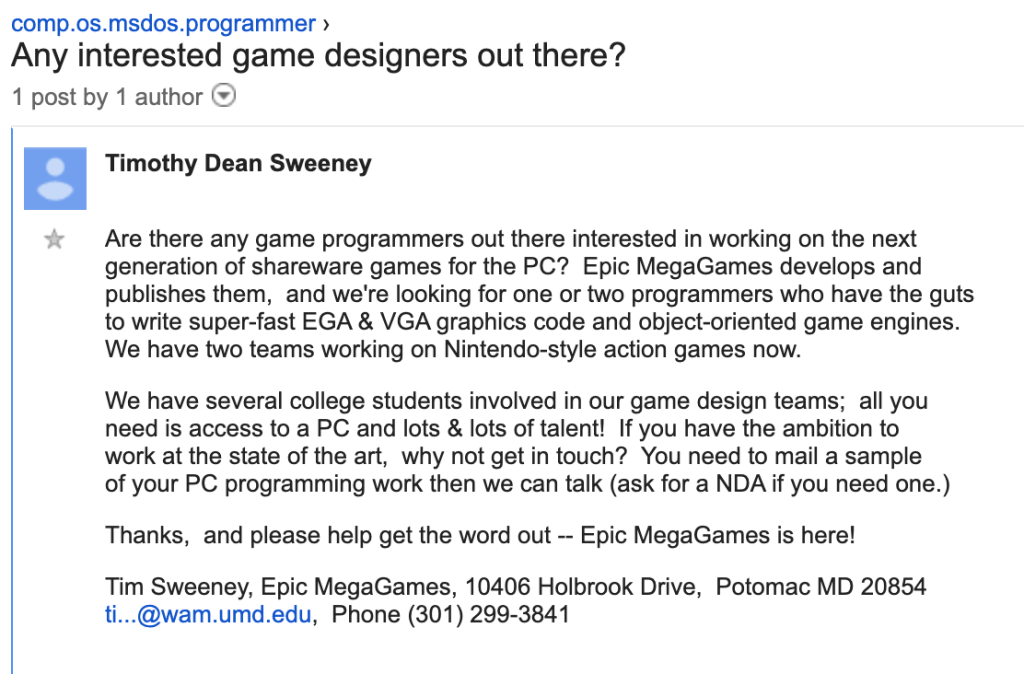
Tim launched Epic MegaGames at 21 to commercialize ZZT with a shareware business model. He hired a number of people and built more and more games, and ultimately created the Unreal Engine, the software-development environment for programmers to build video games of their own. As the gaming industry began to pivot towards gaming-as-a-service, Epic reached out to Tencent for their assistance, who invested $330MM in Epic in 2012.
In the meantime, Epic was building many different games, one of which was Fortnite. The game had experienced development delays but its main game mode, “Save the World”, a player versus environment (“PvE"), was almost ready. Finally, in 2017, Epic quickly followed in the footsteps of PlayerUnknown's Battlegrounds, which essentially introduced the masses to the extremely viral battle-royale game mode. Epic’s rendition of the “Hunger Games” mode was called Fortnite Battle Royale, which they quickly built into the base game as a separate mode. The game instantly went viral, with a player count of greater than 125 million players by May 2018.
What does this mean and why does it matter?
Everyone and their mother was playing Fortnite. Developers laughed at a game that was free to play, a massive shift from the typical gaming model of charging $60+ for the game and more for expansion packs. But Epic ended up having the last laugh - there were estimates the game had earned over $1 billion by July 2018 through microtransactions and its subscription battle pass system.
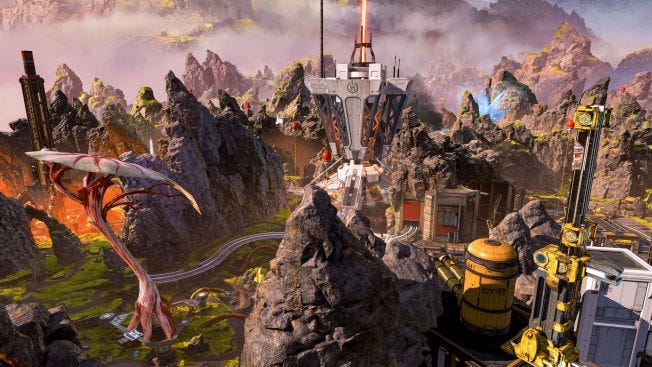
Soon, every game franchise and studio had seen the promise and released their own take of the Battle Royale to capture players’ love for the mode - Battlefield, Call of Duty, Apex Legends, Fall Guys, and many more.
But Fortnite succeeded in being one of the first movers and doing more with their world than others had. Creating an ever changing map, an in-game economy and currency, in-game social abilities to dance, emote, chat, and show off your “skins”, or clothing, and more. This represented a major gamble on the future of gaming not only being just about playing, but also about being a social avenue through which to live and interact with others.
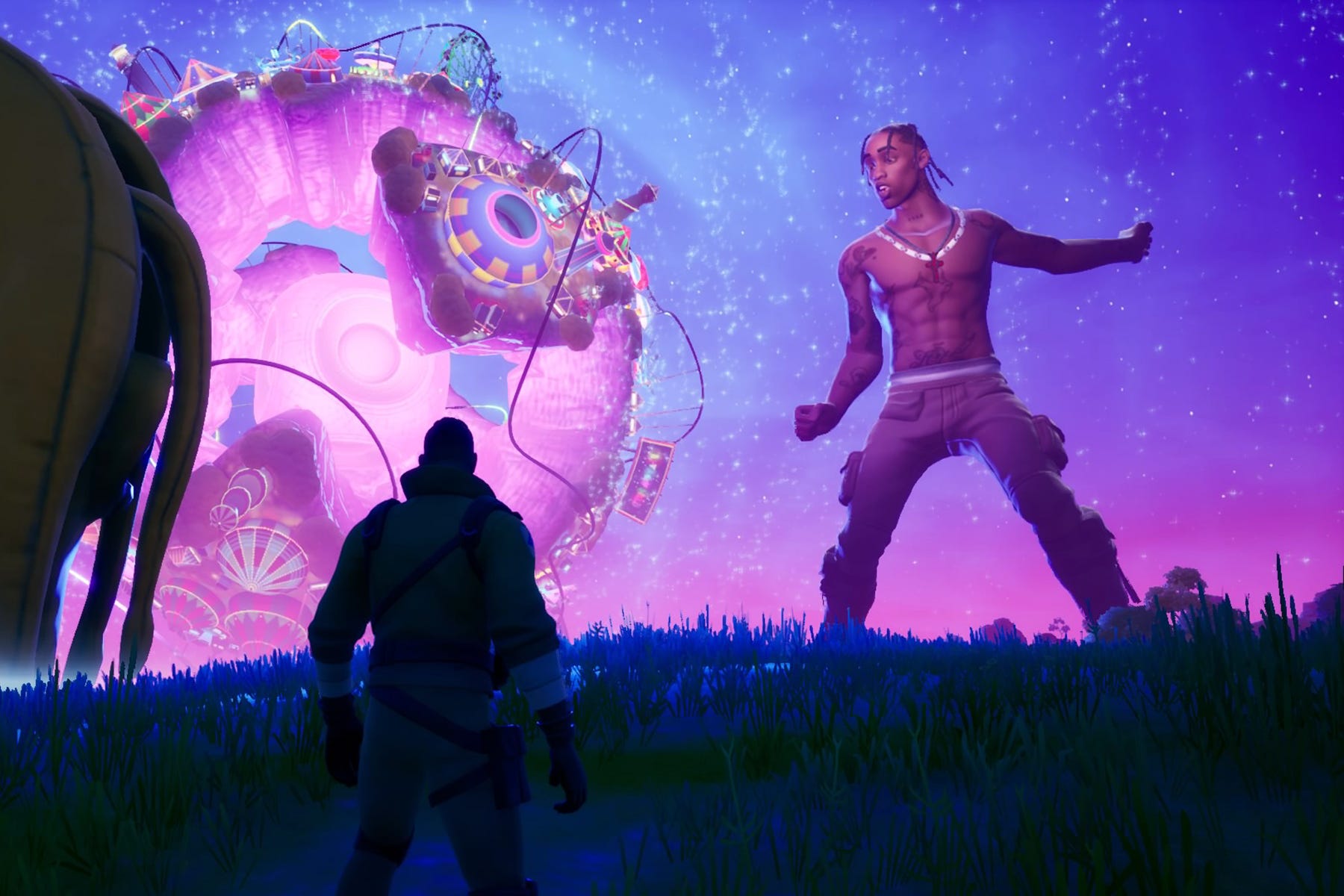
Fortnite hosted an in-game concert led by Travis Scott (the video has 186 MM views), has promotional weapons, game-modes, and story telling to help drive player counts for the game year round, in addition to much-much more. Fortnite has become more about being social and spending time with friends than anything else. I hop on now and then just to reconnect with friends that live in different countries or in other time zones and catch up.
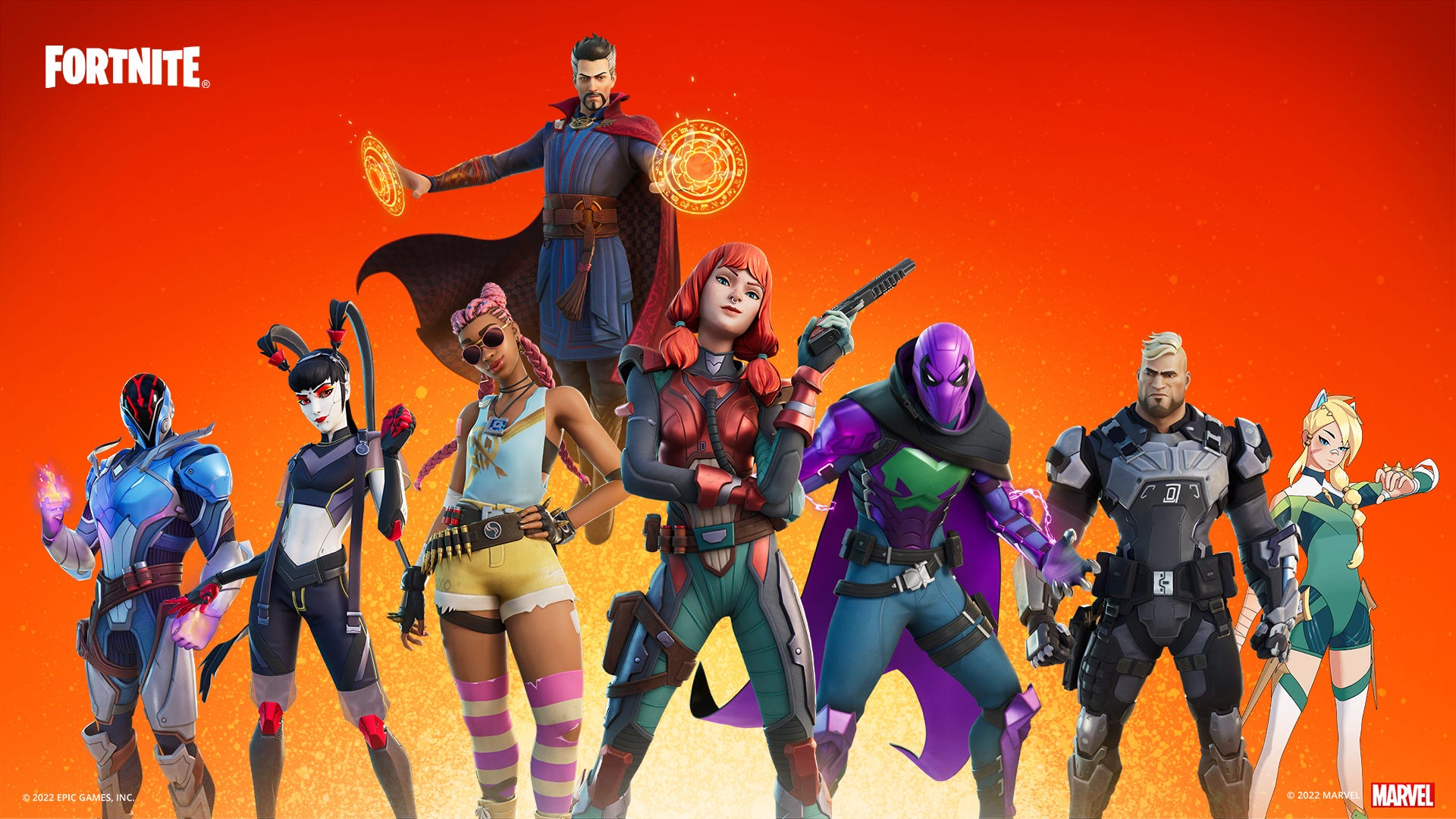
Gaming is a huge space that I doubt will wane in popularity and Epic is poised to take advantage of it. They will continue to pump out content across the gaming space to appeal to a wide range of audiences. The question is, whose metaverse that is being built will be compelling enough to attract and keep the masses? There is an underlying message here that our world is moving more and more into the virtual realm. What’s crazy with Fortnite is that people (kids) who use and used the platform as one of their primary social avenues today and during the bulk of the pandemic were reported to suffer from bullying. Kids have been cited to be bullied or not even played with if they don’t have the latest and greatest virtual costumes that they need to spend money in order to get.
Another risk Epic faces is via their marketplace take rate. Epic leads the industry with a modest 12% cut, but their business model is highly dependent on it and is something to consider if competitors were to push downwards. Another point I would be curious to investigate is how many Unreal Engine licenses are actually needed today and projected to be needed in the future for the development of games across gaming studios…
It is well-known that web3, the power of crypto currency, and the metaverse are all real and here. It is only a matter of time before we find ourselves interacting with them each and every day. I hope that we can reap all the benefits of new technologies, places, and experiences, while also keeping our gratitude and appreciation great for what exists only in our “offline”, real world. For more on virtual worlds and how we will interact with them, check out Rex Woodbury’s post here.
This weekend was my last in Murray Hill!
I’m moving to Greenwich Village at the end of this week and am very excited. Given how often these final sentences are about food and the meals I have, I’m sure you can imagine how much I am looking forward to being in the center of so many great restaurants and bars. I will definitely miss my current spot for the awesome roof, wonderful open kitchen which has welcomed many friends for meals and drinks, and the spaciousness to have people over and share memories together.



In honor of leaving, I decided to try a new spot that opened near my Murray Hill apartment called GG Tokyo. It’s a Japanese speakeasy that serves awesome cocktails and an assortment of Japanese-based raw and cooked dishes. The aesthetic, food, drinks, and vibe were all awesome. I will certainly be going back and highly recommend it.


Dr. Strange 2: Multiverse of Madness was a laughable mess of a movie.
The movie was gorgeous and had a number of awesome Easter eggs, cameos, and comic book shout-outs, but the plot, character development, and logic based in the movie was poorly developed. I’d write more but don’t want to spoil it for those who haven’t seen. If you want to see my full movie review and recap (and a potential rewrite of the script), check out my take here on Letterboxd.
GW
Adding GG to da list