
How does that old expression go?
You have to spend money to make money.
Yes, the dumb phrase my friends (or me) occasionally use to justify mindless purchases we make (such as buying a few grand worth of ski gear you wear once a year, flying to Miami for 48 hours, or having a few too many drinks at an expensive bar - lads you know who you are) but as I’m sure you know, it’s a common English saying.

The phrase is supposed to emphasize the importance of spending money on supplies, products, advertisements, or other business expenses for the purpose of growing your business. And from my post on Pipe / CapChase as well as our understanding of tech’s growth at all costs mindset, we know just how important getting cash *and* spending it properly is.
Now the only questions left to ask are,
What are the pain points that companies face in spending?
And based on the above - How can businesses spend their money in the most efficient and convenient way?

To the pain points, many companies lack real-time visibility into their companies spending and as a result overspend. This forces companies to guess when making important financial decisions that can directly affect their bottom line. Companies also end up wasting one of their most precious resources, cash, that can be better used elsewhere.
Companies in the corporate spend management and financial automation space are creating products that will save companies money thru cost-savings, and their employees’ time and productivity.
This space is huge right now. Let’s talk through just a few of the active players:
In the last 12 months
Ramp has raised $1.215 billion over 3 different funding rounds.
Divvy was acquired by Bill.com for $2.3 billion in June 2021.
Brex, where one of my friends works (shoutout Arny), has raised $725 million over 2 different funding rounds.
Moss has raised $140 million since January 2021 over 2 different rounds.
Spendesk has raised $215 million in a Series C round in January 2022.
Teampay raised $26.9 million in a Series B1 round in October 2021.
Airbase raised $60 million in a Series B round in June 2021.
Ramp, is just one of the companies in this space that is making headlines.

“Ramp's platform is used by over 5,000 businesses and its revenue grew nearly tenfold in 2021.”

Ramp is a fintech startup that offers physical and virtual corporate credit cards along with software for managing expenses. And they do it for free.

To get some more perspective on Ramp’s growth (and investor appetite), let’s dig a bit deeper into their fundraising history (on a post-money basis) below:
December 2020 : 212MM | 32MM raised
April 2021 : ~1,100MM | 115MM raised
5.2x valuation jump in ~4 months
September 2021 : 3,950MM | ~351MM raised
3.6x valuation jump in 5 months
March 21, 2022: 8,100MM | 750MM raised
2.1x valuation jump in 6.5 months
As you can see, the valuation has jumped roughly 40X in around 15 months. This is lightning fast, and even its late March raise has defied the hesitation and turmoil that has plagued both private and public markets in recent months.
In March, Ramp raised its $750MM round, comprised of $200 million in equity and $550 million in debt. The round was led by Peter Thiel’s Founders Fund and was accompanied by D1 Capital Partners, Thrive Capital, Redpoint Ventures, Coatue Management, and Stripe. General Catalyst and Avenir Growth Capital were among the new investors.
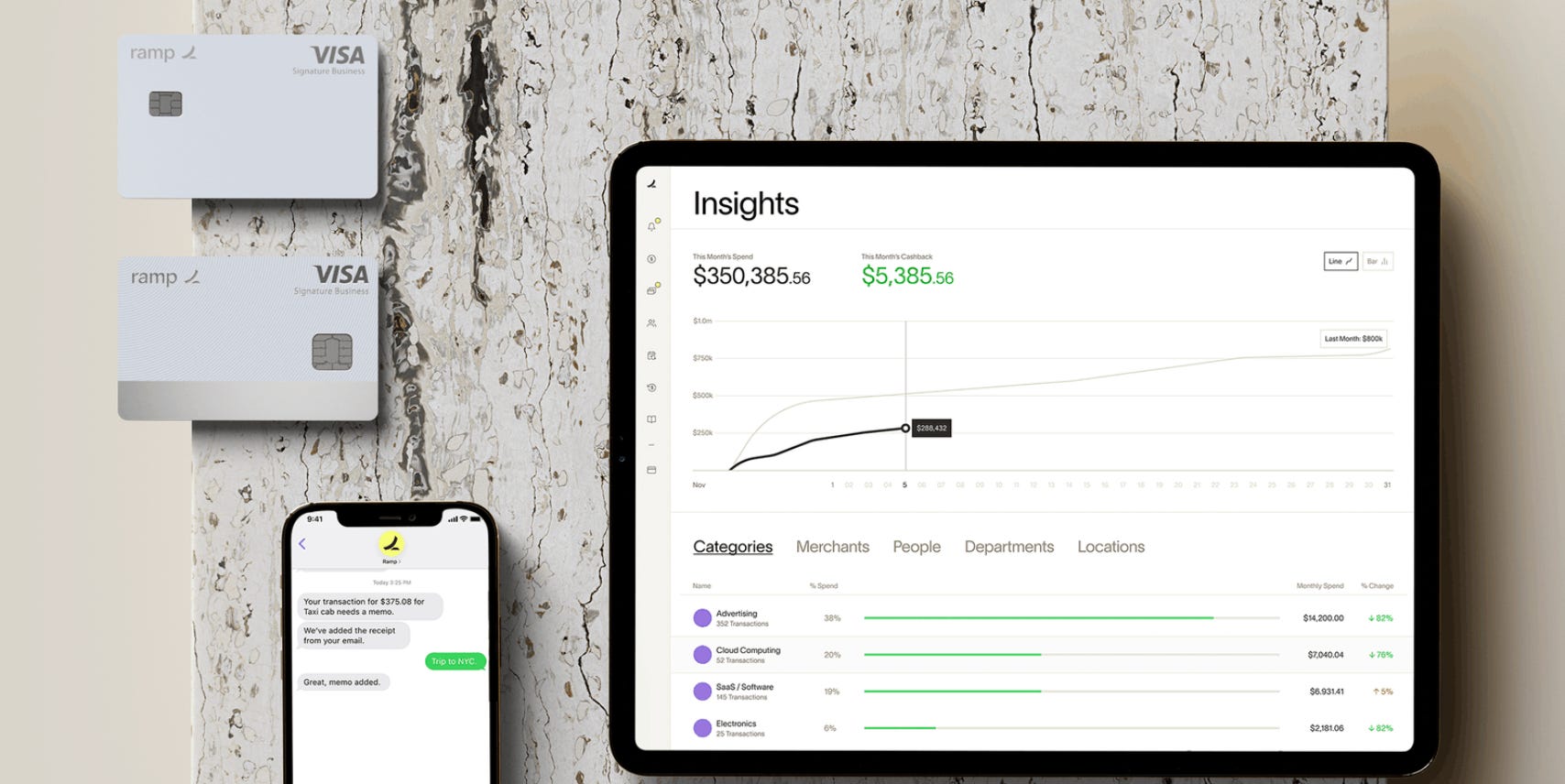
Ramp offers a few things, but in simple terms, Ramp offers corporate credit cards and expense management software.
Ramp issues physical and virtual Visa credit cards to employees for any startup. Add your brand’s logo to the card, block or restrict spend to a specific vendor, fine-tune spending limits and categories, with a software platform to manage it all; it’s possible with the Ramp credit card. Perks on the charge card include unlimited 1.5% cashback, no personal guarantee (meaning you are not personally held responsible for company debt repayment), no interest payments, high credit limits, and no fees of any kind.
Before we talk about how Ramp makes money, let’s go thru a few more of the features of the platform:
Spending Customization
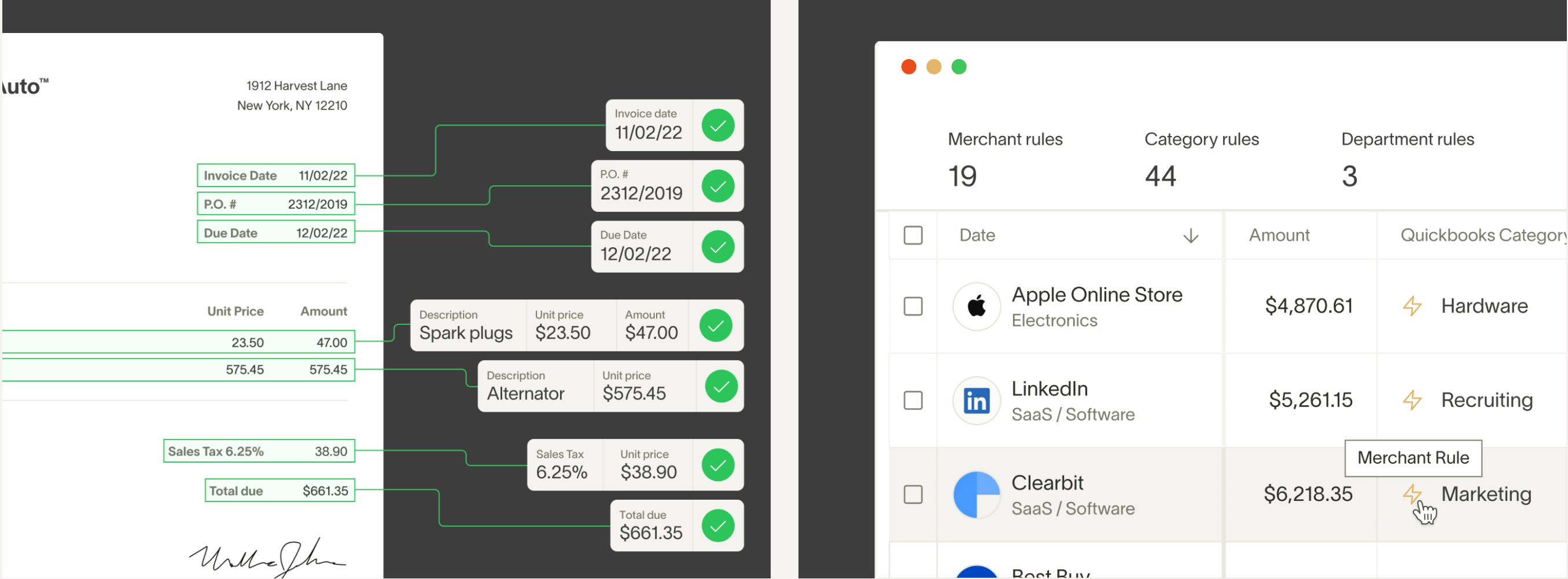
Set rules for employee spending with alerts, spending limits, prohibited vendors / categories / types of transactions, memo thresholds, repayment requests, card locks, necessary out-of-policy expense approvals, and integrations with communication channels.
Expense Automation
View, manage, and categorize transactions in real-time, supplemented with the power of AI and ML.
Bill Payment
Process hundreds of invoices and pay via card, ACH, or check fast.
Detailed Accounting
Help you keep up-to-date books that close on-time faster
Integrations with products such as
Expense Automation vendors such as Amazon Business, Lyft, Corporate Travelers, TravelPerk, and more
Productivity products such as Justworks, BambooHR, Hibob, Rippling, Slack
Accounting products such as Intuit QuickBooks, NetSuite, Sage Intacct, Xero
Security products such as Okta, 1Password, Google Suite
Saving
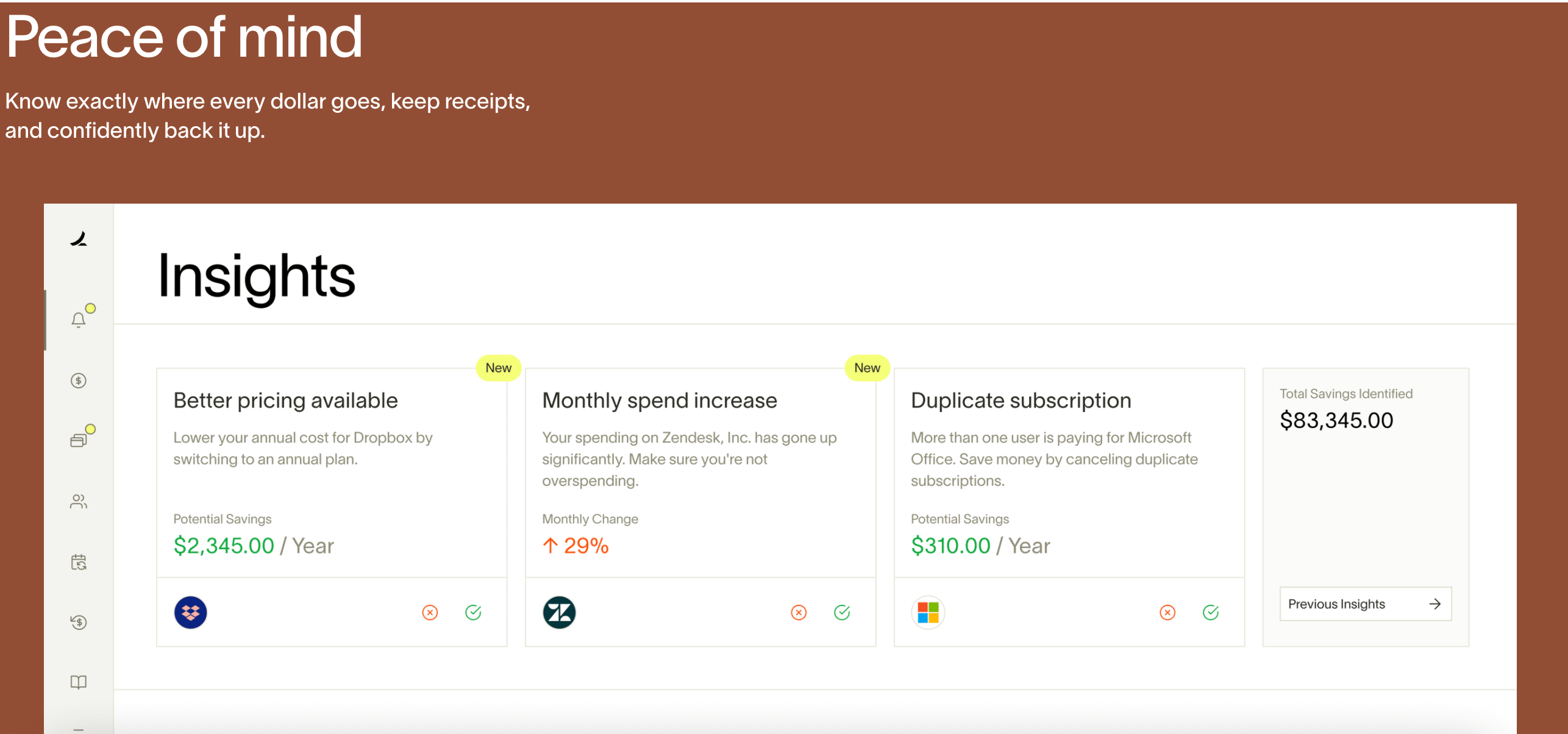
Every transaction is analyzed for duplicates, missing cash-back, unclaimed rewards, and thousands of other ways to save money. Utilizes pricing intelligence to compare the costs of your subscriptions or products to similar ones in the market.
Also offers a product from a company they acquired in August, Buyer, to negotiate better software deals for you.
How do they make $?

Ramp, like many of its rivals, makes money by collecting a small slice of every transaction (typically 1-3%) that merchants pay in fees, known as interchange. Ramp partners with Visa, meaning that Visa collects this interchange, but passes the majority of the fee to Ramp since the cards are yet another avenue for Visa revenue.
It is important to note that since Ramp is a charge card and not a “credit” card, Ramp doesn’t make money on interest.
When looking at Ramp’s market opportunity, let’s examine Packy McCormick of Not Boring’s piece on Ramp,
Ramp earns interchange – 1.5-2.5%, paid by merchants and card networks – when customers spend using the card. Taking ~2% of the $1.5 trillion (and growing) companies spend on cards every year is a $30 billion (and growing) annual opportunity. Plus, it’s essentially inflation-proof since it’s indexed to total spend – as businesses spend more, Ramp makes proportionally more. That might be one of the reasons AmEx has done well while growth companies have tanked.
-Packy McCormick, Not Boring
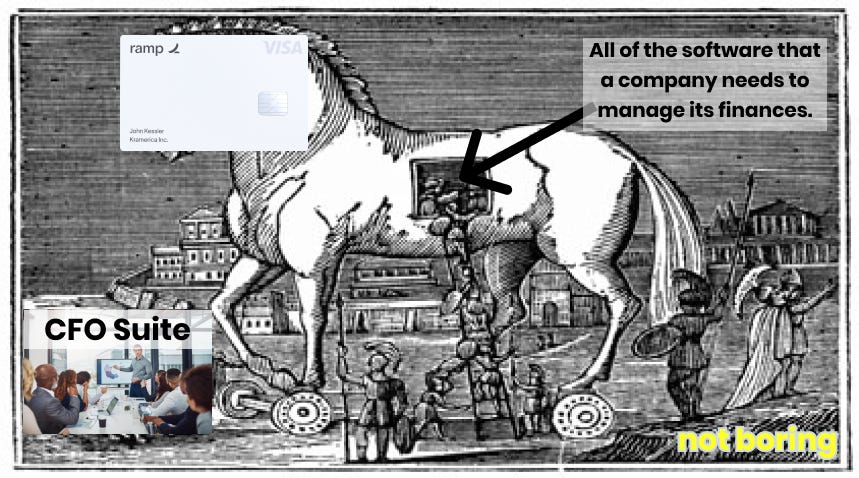
But, as Packy states and we will re-emphasize, comparing our TAM to Amex’s is a haircut and disservice to Ramp’s total potential. At the end of the day, Amex and others are simply spending companies. Ramp is a technology company focused on saving customers time and money, and they disguise their incremental offerings under the guise of “just a simple corporate credit card”. Not Boring has a hilarious illustration of this in the form of the Trojan Horse, showing that Ramp’s credit card is like the entry ticket to the rest of their offerings.
Some good ole fashion competition
I’ve had this newsletter on Ramp in the pipeline since their raise back in March. As I continued to do my research and refine the piece, I found out thru a friend that Brex, a competitor, would be making a product announcement on April 13, 2022. I am going to add the details of the product announcement below because it represents an important shift in thinking for this space.

Writing this on April 13, this new product is called Empower. Empower is Brex’s totally new and improved software platform for spend management. They also announced a major customer win, DoorDash, a company with 8,600 employees worldwide as of 12/31/21. Empower does a few things for Brex to push its platform forward:
Empower facilitates automatic receipt collection by harnessing data from credit card networks and many integrations, meaning employees don’t have to provide them in expensing.
Empower integrates the company’s expense policy, budget, and other relevant details directly into the Brex app so that employees can see the expense policy and how charges will be managed based on it, at any time.
Empower shifts Brex’s expense approval system away from “request-approve-review” to trust-and-verify, thru the creation of a budget feature that automatically greenlights certain types of in-policy expenses, reducing the number of expenses managers need to review
Empower enables real-time spend management and accounting so financial decisions can be made in real-time and books can be closed even faster.
If you want to learn more about Brex (and how it differs from Ramp), feel free to check them out at brex.com. This announcement is important because it emphasizes a few important trends to keep an eye on.
These spend startups are new dogs with newer tricks

The credit card serves as the “freemium” entry product that will hook companies, creating dependence on Ramp, Brex, etc. for their software as their financial / spend operating systems.
Spend management companies are moving up-market to focus on companies that spend more and are larger in scale.
Larger companies = More spend = More transaction fees = More revenue
But ALSO larger companies = more opportunities to sell / upsell ancillary services (via the Trojan Horse methodology)!
Spend management companies are growing increasingly competitive and will race to capture international markets
Some additional risks inherent in Ramp include:
The platform doesn’t provide lucrative rewards or travel perks but does provide a simplistic cashback system
Charge card so you cannot carry a balance
Moving up-market where there is fiercer competition from competitors and where they do not hold the first-mover advantage
Revenues are indexed to total spend so in times of recession revenues will be hurt
How does CAC (and LTV / CAC) look for a company where revenues (not profits) are derived from a 1-3% transaction fee?
Potential for large card payment players such as Amex, Visa, Mastercard, Discover to build out more all-encompassing corporate spend software or acquire it, serving as legitimate competitors.
How will the world of payments change with the proliferation of cryptocurrency (such as Solana Pay) which reduces interchange fees and saves merchants 2-3% on transactions as well as time in receiving funds?
This week marked the kickoff of Passover, the Jewish week-long equivalent of Keto. To properly send us off, I went wild on pasta
Thursday I managed to get away to L’artusi with some friends, a family favorite in the village where all we ate was pasta.

On Friday, I decided to invest some serious time and energy into cooking one of my greatest meals to date. The feast consisted of the following (from top to bottom):

Bang bang roasted cauliflower
Chili sauce, sriracha, honey, olive oil, lemon juice
Salmon with a home-made teriyaki sauce topped with sesame seeds and green onion
Teriyaki sauce consists of soy sauce, mirin, and sake
The Grand Finale →*Made from scratch* Red beet gnocchi with a pistachio pesto

Along with this, I did a Passover Seder with my college friends for the first time. I enjoyed it so much and was touched because I got to show them my culture and heritage, something they may not have been as aware of before and I frankly wish I had done earlier. Don’t be afraid to share all of yourself with the people you care about.
GW